Honor Chasm
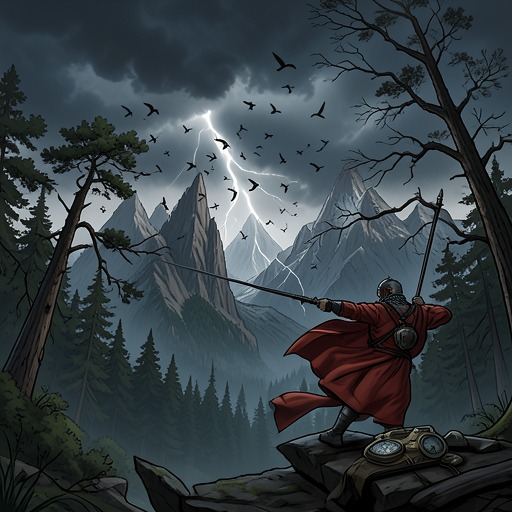
The Way of KingsHonor Chasm is a chasm on the Shattered Plains associated with the bridgemen’s final act of self-determination: death. It is not merely a dangerous feature of the landscape. The bridgemen name it for the grim choice available at its edge, and its existence turns the broken land into a direct image of the social violence imposed on them.
Physical Setting
Honor Chasm begins as a narrow crack and widens and deepens with astonishing speed as it runs east. After only ten feet, it is already too broad for an easy jump, making the danger legible even before the chasm reaches its greater depths. The text emphasizes that these formations are not natural-looking breaks in ordinary ground; the land has been shattered into abrupt, hostile fissures.
Six rope ladders with wooden rungs hang from spikes driven into the rock beside the chasm. They are not installed for exploration or travel, but for bridgemen sent down to salvage the bodies of men who have fallen during bridge runs. The ladders therefore give the chasm a practical function within the war as well as a symbolic one: it receives the dead, and the same laborers who risk their lives above are made responsible for retrieving corpses below.
The Bridgemen’s “Honor”
The bridgemen call the place Honor Chasm because it offers what they regard as the one decision left to them. The name is bitterly ironic. In a world where bridgemen are compelled to carry bridges through battle and treated as expendable, the chasm’s so-called honorable decision is not freedom in any generous sense, but the choice to end a life already controlled by others.
The location thus exposes the meaning of agency under the bridgemen system. Their daily movement is dictated by war, command, and the bridge runs; at Honor Chasm, agency survives only as a decision over whether to continue. The ropes and ladders reinforce that contradiction. The chasm is prepared for the bodies of the condemned, while the living are expected to descend into it afterward and recover what the army has lost.
Kaladin at the Edge
Kaladin comes to Honor Chasm in wind-driven rain after the bleeding eyes of an unnamed boy have continued to haunt him. The memory has made the possibility of another death unbearable, yet it has not given him an easy alternative. He struggles even to decide to go there, an indecision the narrative connects to the effects of battle and shock among bridgemen.
At the chasm, Kaladin walks past the ladders and sits with his legs over the edge, watching the rain disappear into the darkness. The scene places the living man beside the equipment used to recover the dead and makes the void an immediate, physical presence rather than an abstract thought. His accumulated suffering presses into the moment: scars, falls, accidental killings, and the memory of having lived beside men he regarded as morally ruined all converge at the lip of the fissure.
When Kaladin stands, he feels his father’s disappointment above him like the thunderheads overhead. He then puts one foot over the void. The gesture marks the location’s decisive dramatic function: Honor Chasm transforms despair into an imminent act, shifting Kaladin from someone contemplating death to someone physically beginning to choose it.
Interruption and Narrative Significance
Kaladin does not fall. Sylphrena’s soft but piercing call stops him, and he draws his foot back before holding out his hand to her. Her arrival interrupts the chasm’s apparent finality and changes the scene’s value from death toward continued connection. Honor Chasm remains the place where Kaladin nearly ends his life, but it also becomes the threshold at which another possibility reaches him.
The location’s force comes from the contrast between its stated purpose and its dramatic outcome. For the bridgemen, it represents the last available decision; for Kaladin, it becomes the setting of a decision interrupted before it can become irreversible. Its broken geology, corpse-retrieval ladders, and human history all converge in that reversal, making Honor Chasm one of the clearest places where the Shattered Plains’ physical devastation mirrors the destruction of the people sent into them.